
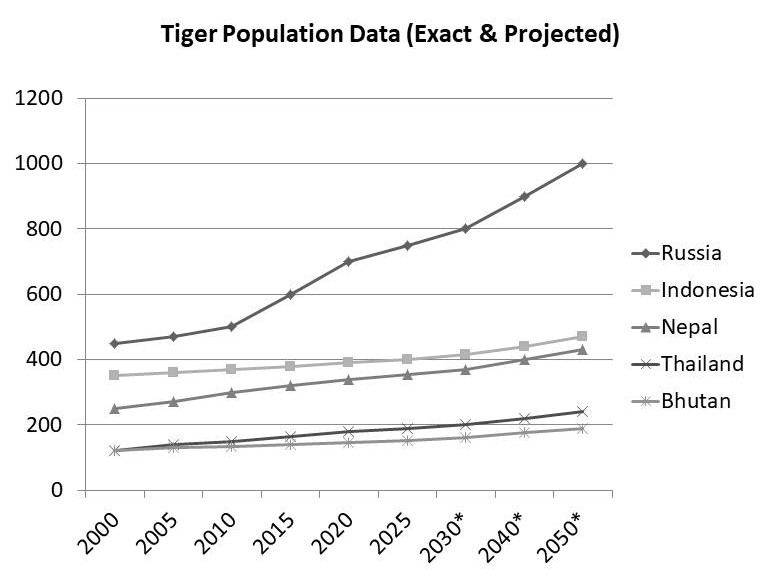
You should spend about 20 minutes on this task. The graph below shows the population of Tiger, in Russia, Indonesia, Nepal, Thailand and Bhutan from the year 2000 to the present day with projections for growth to the year 2050. Summarise the information by selecting and reporting the main features, and make comparisons where relevant. Write at least 150 words.
| Answer |
The graph illustrates the tiger populations in five countries, Russia, Indonesia, Nepal, Thailand, and Bhutan from 2000 to the present day, with projections extending to 2050.
Overall, Russia has consistently had the highest number of tigers, while Thailand and Bhutan have the smallest populations. All five countries show steady growth over the period, though the rate of increase varies.
In 2000, Russia’s tiger population stood at 450, significantly larger than the other countries. Indonesia followed with 350, while Nepal had 250. Thailand and Bhutan had the smallest numbers, both at 120. Over the next 25 years, Russia’s population grew substantially, reaching 750 by 2025, and is projected to hit 1,000 by 2050.
In contrast, the other countries experienced more gradual increases. Indonesia’s population rose from 350 in 2000 to 400 by 2025, with a projected rise to 470 by 2050. Nepal, Thailand, and Bhutan also saw moderate growth, with Nepal increasing from 250 to 355 by 2025 and expected to reach 430 by 2050. Thailand and Bhutan, though starting with the smallest figures, followed a similar upward trend, with Thailand projected to reach 240 tigers by 2050 and Bhutan 190.
In summary, while Russia dominates in tiger numbers, all five countries show positive growth trends, with projections indicating continued increases over the next few decades.
Tip: Complete each section under timed conditions (20 minutes per passage) before checking answers.
For practice purposes only