
In the Academic Writing section of IELTS, you'll have one full hour to finish two writing tasks. The first one is shorter and worth one-third of your total score, while Task 2 is longer and worth two-thirds. If you're practising at home, try to keep the timing realistic. Spend about 20 minutes on Task 1, and save 40 minutes for Task 2. In the real exam, you'll move straight from Task 1 to Task 2 without a break, but during practice, you might choose to review your Task 1 attempt before starting Task 2, or finish both and then check your answers afterwards for a more exam-like feel.
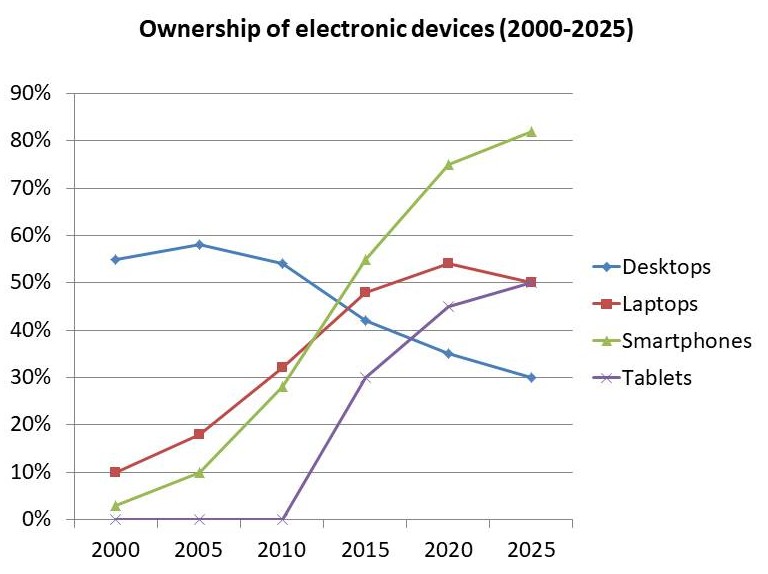
The chart below shows the percentage of households worldwide that owned four types of electronic devices—desktop computers, laptops, smartphones, and tablets, from 2000 to 2025.
Summarise the information by selecting and reporting the main features, and make comparisons where relevant.
| Answer |
The bar chart illustrates the proportion of households worldwide that owned four types of electronic devices, desktop computers, laptops, smartphones, and tablets, from 2000 to 2025, with projections for the final year.
Overall, desktop computers were the most prevalent devices in 2000, but smartphones overtook all other categories by 2015 and are projected to remain dominant. Meanwhile, laptops and tablets have shown steady growth, while desktops have declined significantly.
In 2000, 55% of households owned desktops, far surpassing laptops (10%) and smartphones (3%). Tablets had not yet entered the market. Over the next five years, desktops peaked at 58% (2005), while laptops and smartphones rose modestly to 18% and 10%, respectively.
Between 2010 and 2015, a major shift occurred. Desktop ownership dropped from 54% to 42%, while laptops surged to 48%, nearly matching desktops. Smartphones experienced rapid adoption, skyrocketing from 28% to 55%, becoming the most common device. Tablets, introduced around 2010, quickly reached 30% ownership by 2015.
By 2020, smartphones dominated at 75%, followed by laptops (54%) and tablets (45%). Desktops fell further to 35%. Projections for 2025 suggest smartphones will rise to 82%, while desktops will decline to 30%. Laptops and tablets are expected to stabilize at 50% each, indicating a balanced demand for portable computing
In summary, households worldwide have shifted decisively from desktops to mobile and portable devices, with smartphones leading the trend.
Tip: Complete each section under timed conditions (20 minutes per passage) before checking answers.
For practice purposes only